Behind the Glass Lies a Secret: What You Never Knew About Two – Way Mirrors

Check for Devices Near the Mirror

A hidden camera needs more than a lens.

Depending on the design, it may require power, storage, wireless connectivity, or another way to transmit or save recorded footage.

Look around the room for unexplained electronic devices, chargers, adapters, USB power sources, unusual clocks, smoke detectors, wall fixtures, or other objects facing toward private areas.

Many ordinary objects contain cameras nowadays, so the presence of an electronic device does not automatically mean it is being used for surveillance.

The important question is whether its placement and function make sense.

Don’t Rely on Smartphone Camera Detection Alone

You may also encounter advice claiming that your smartphone can automatically detect hidden cameras.

Some phone cameras can detect certain infrared light sources under specific conditions. However, this is not universal.

Different phones use different camera sensors and filters, and not every hidden camera uses infrared illumination.

Likewise, apps claiming to detect hidden cameras through Wi-Fi or magnetic fields can produce false positives and false negatives.

No single smartphone trick should be considered definitive proof that a room is free of surveillance equipment.

What Should You Do If You Actually Find Something Suspicious?

If you discover what appears to be a hidden camera in a changing room, hotel room, bathroom, or other private area, prioritize your safety.

If possible, leave the private area and move somewhere safe.

Do not unnecessarily dismantle equipment or confront someone you suspect of installing it.

Document what you can safely observe, including the location and appearance of the device, and contact the appropriate hotel management, property owner, security service, or local authorities depending on the circumstances and your location.

In accommodation settings, you can also request a different room or leave the property if you do not feel comfortable remaining there.

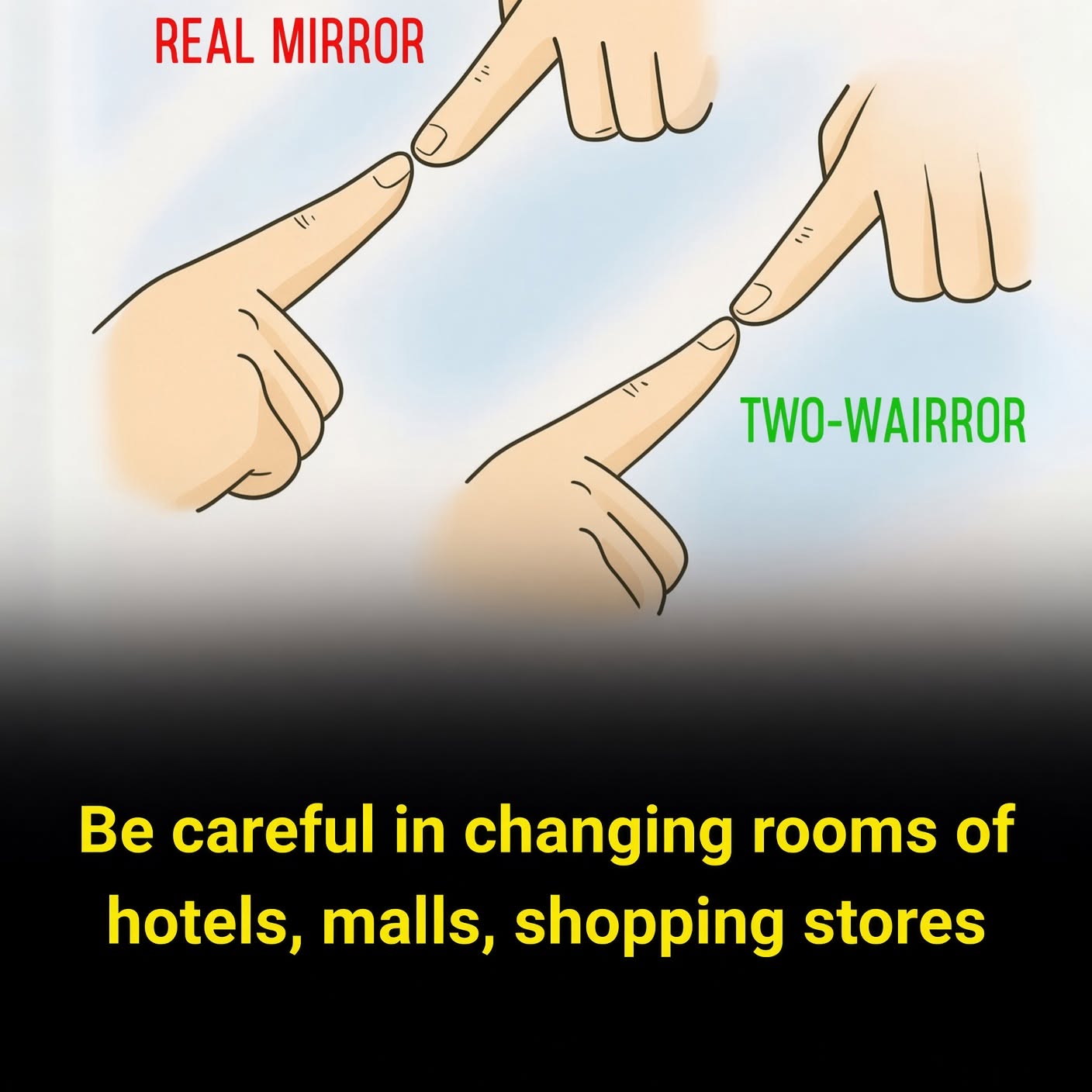
The Finger Test: Useful or Not?

The answer is simple:

It can be interesting, but it is not a reliable privacy test.

A gap between your fingertip and its reflection does not guarantee that the mirror is safe.

A fingertip touching its reflection does not prove that the mirror is a two-way mirror.

And neither result tells you whether a hidden camera exists elsewhere in the room.

The test is based on the physical construction of mirrors, but viral posts often exaggerate what that observation can actually tell you.

Final Thoughts

Privacy concerns in hotels, changing rooms, rental properties, and other private spaces are understandable.

But when it comes to checking mirrors, don’t rely entirely on the viral “finger test.” Mirror construction varies, and the test cannot reliably identify two-way mirrors or hidden cameras.

Instead, take a broader approach: examine the mirror’s installation, look for unusual gaps or objects, inspect suspicious electronics, consider lighting conditions, and pay attention to anything that appears out of place.

Most importantly, remember that a suspicious-looking mirror is not automatically evidence of surveillance.

If you genuinely discover a device that appears designed to record people in a private area, prioritize your safety and report it through the appropriate channels.

The best protection is not one viral trick. It is careful observation, common sense, and knowing the limits of the tests you are using.

This article is for general informational purposes and does not replace local legal advice or professional security assistance.

There’s more to discover. Continue to the next page for the rest of this article.