Behind the Glass Lies a Secret: What You Never Knew About Two-Way Mirrors
How to Check a Mirror for Hidden Cameras: What the Finger Test Really Tells You
If you have ever walked into a hotel room, changing room, public restroom, or other private space and wondered whether a mirror could be hiding a camera, you are not alone.
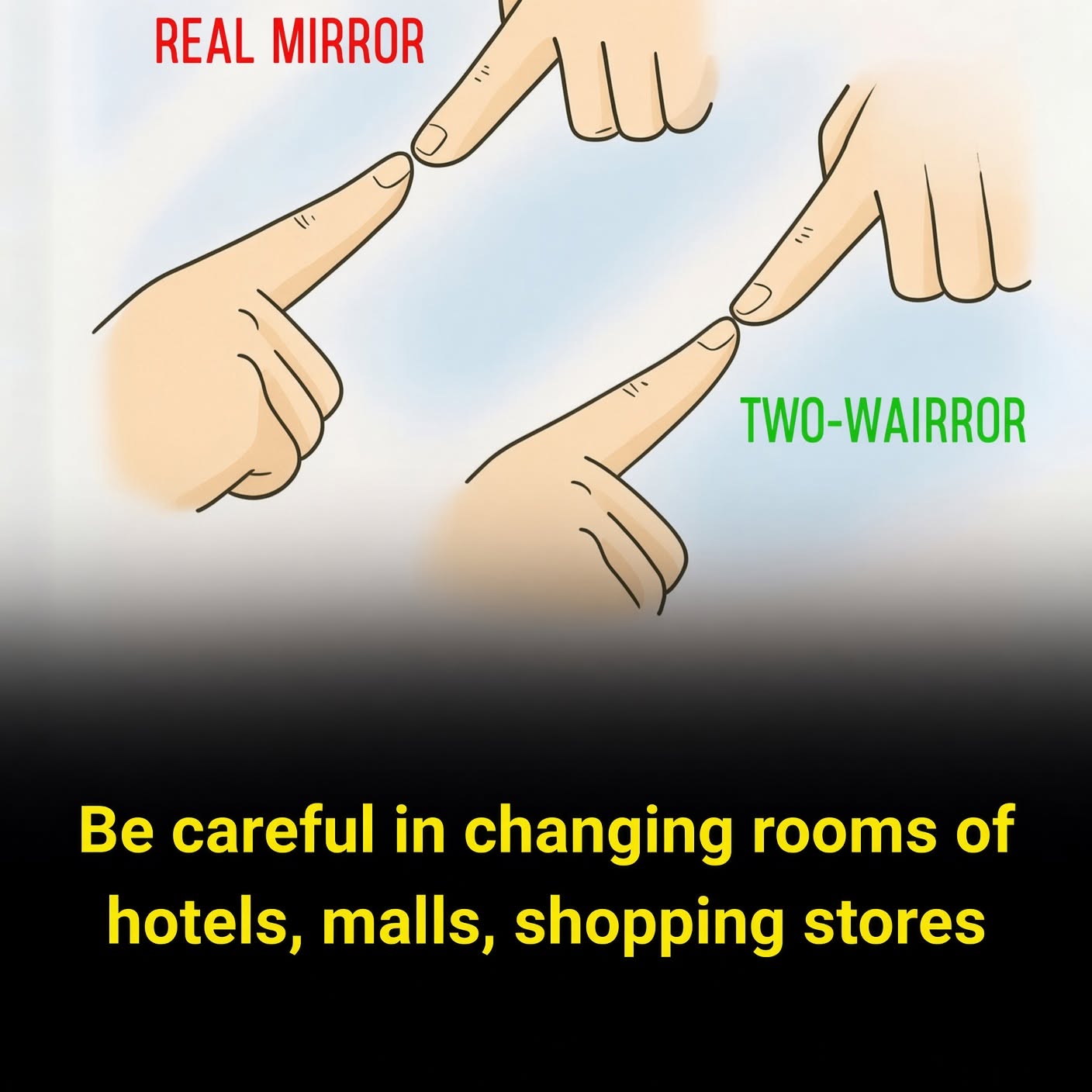
The image above shows a popular internet trick sometimes called the “finger test” or “fingernail test.” The idea is simple: place your fingertip against the mirror. If there appears to be a gap between your finger and its reflection, the mirror is supposedly “real.” If your fingertip seems to touch its reflection directly, the mirror is supposedly a two-way mirror.
It is an interesting visual trick—but it is not a reliable way to determine whether a mirror is hiding a camera or whether it is a two-way mirror.
Understanding why can help you protect your privacy without relying on viral misinformation.
What Is a Two-Way Mirror?
A two-way mirror, sometimes called a one-way mirror depending on the viewing conditions, is designed so that light transmission and reflection differ between two sides.
Its effect depends heavily on lighting conditions.
The brighter side generally sees more reflection, while someone on the darker side may be able to see through the glass toward the illuminated area.
This is why these mirrors are sometimes used in observation rooms, interrogation rooms, security applications, and other specialized environments.
A two-way mirror is not necessarily a magical piece of glass that looks completely different from an ordinary mirror.
Why Does the Finger Test Sometimes Show a Gap?
A traditional household mirror usually has a reflective coating behind a layer of glass.
When you place your finger against the front surface, the glass creates a small physical distance between your fingertip and the reflective coating.
As a result, you may see a small gap between your fingertip and its reflected image.
However, the size of that gap depends on the construction of the mirror.
Different mirrors can have different glass thicknesses, reflective coatings, mounting methods, and optical properties.
Therefore, a visible gap does not prove that the mirror is safe.
What If Your Finger Appears to Touch Its Reflection?
This is where the viral claim becomes misleading.
Some mirrors can produce an apparent “touching fingertip” effect even though they are not secretly hiding a surveillance device.
Conversely, the absence of a visible gap does not prove that a mirror is a two-way mirror.
The finger test cannot reliably distinguish a normal mirror from a two-way mirror.
So if you see an image online claiming that touching your finger to a mirror is a definitive privacy test, treat that claim skeptically.
A Two-Way Mirror Is Not the Same Thing as a Hidden Camera
Another important distinction is often missed in viral posts.
A two-way mirror and a hidden camera are two different things.
A two-way mirror is a type of optical arrangement that can allow observation from one side under suitable lighting conditions.
A hidden camera, on the other hand, is an electronic device that records or transmits images.
A room could theoretically contain a hidden camera without having a two-way mirror at all.
Likewise, a mirror could have unusual optical properties without containing a camera.
Therefore, checking the mirror alone does not necessarily answer the bigger question: Is there a recording device nearby?
Look at the Mirror’s Installation
If you are genuinely concerned about privacy, pay attention to how the mirror is installed.
A mirror that appears unusually deep, has unexplained gaps around its edges, or is mounted in an unexpected location may deserve closer inspection.
Look for anything that seems inconsistent with the surrounding room.
For example, an unexplained opening, tiny hole, unusual electronic device, or object positioned toward a bed, shower, changing area, or other private location could warrant further investigation.
However, don’t assume that every small hole or reflection is a camera. Many ordinary fixtures contain sensors, screws, ventilation openings, LEDs, or other components.
Check the Lighting
Because two-way mirrors rely partly on differences in illumination, lighting can provide useful information.
If you are in a private space and the mirror seems suspicious, you can observe whether there is an unusual difference in lighting between the mirror area and the surrounding room.
In some circumstances, darkening your side of the glass while illuminating the area behind it can make a transparent or semi-transparent arrangement easier to identify.
But this should not be treated as a foolproof test.
The physical construction of the mirror, the room layout, and the surrounding materials all matter.
Look for Unusual Reflections
Another practical step is to examine the mirror from different angles.
Move slightly to the side and observe whether the reflection behaves consistently.
You can also inspect the edges of the mirror if they are accessible.
A normal mirror generally has predictable reflective behavior. But unusual reflections, visible spaces behind the glass, or an unexpected second layer may provide additional clues.
Again, one observation is not enough to prove the presence of surveillance equipment.
Use a Flashlight Carefully
A flashlight can sometimes help identify unusual features behind or around a reflective surface.
In a dim room, shine the light across the mirror rather than directly staring into it.
Look for unexpected openings, objects, wires, or structures that might be visible through gaps.
This technique is not guaranteed to detect hidden cameras because modern devices can be extremely small and may be positioned behind opaque or reflective materials.
Still, it can be one component of a broader privacy check.
But checking the mirror itself is only part of the picture—there are other objects and devices in a room that may deserve a closer look.
There’s more to discover. Continue to the next page for the rest of this article.