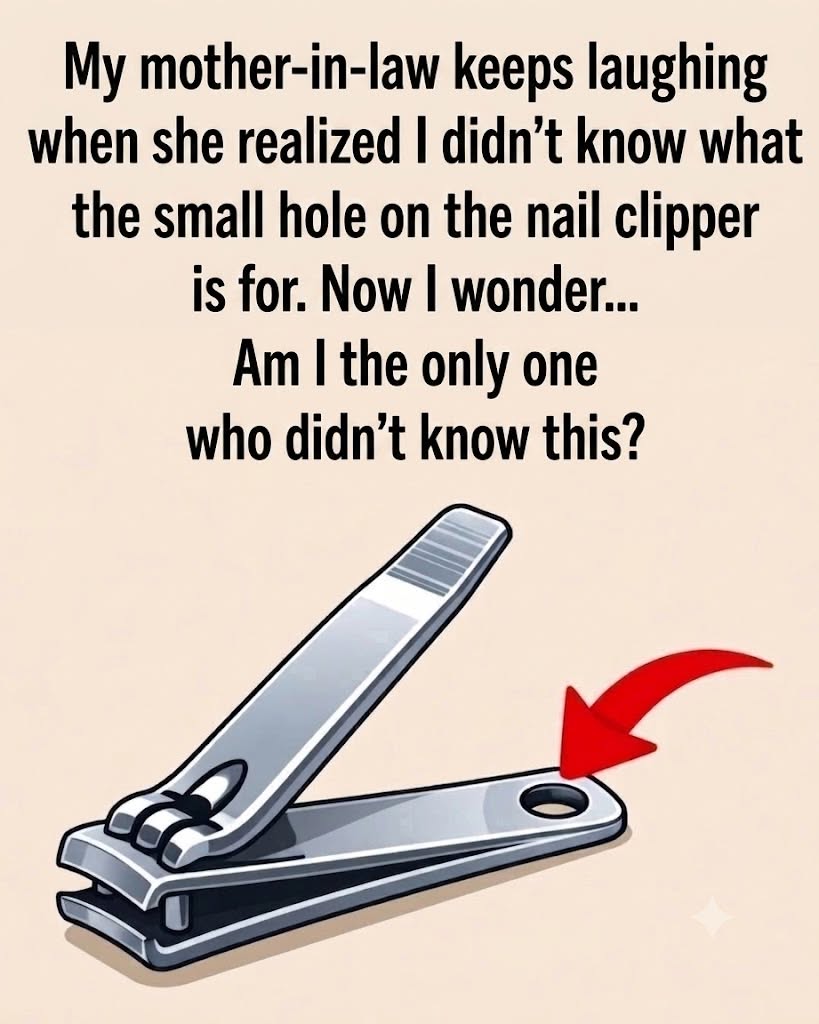
The Forgotten Utility: Why Is There a Tiny Hole on a Nail Clipper?
A nail clipper is one of those everyday objects most people use without ever thinking twice about its design.
You probably keep one in your bathroom cabinet, travel bag, desk drawer, or somewhere else within easy reach. You use it to trim your fingernails and toenails, perhaps every week or two, and then put it away.
Simple, right?
But if you take a closer look at a traditional nail clipper, you may notice a small round hole near the end of the metal lever.
At first, it can seem completely unnecessary.
Why would a tool designed simply for cutting nails need a hole?
Is it there for manufacturing? Is it decorative? Does it have something to do with how the clipper works?
The answer is more practical than many people realize.
That tiny opening is often part of the clipper’s lever and pivot design, and depending on the model, it can also serve additional purposes.
Here’s what that little hole is really about.
The Nail Clipper Is a Small Mechanical Tool
Before looking at the hole itself, it helps to understand how a nail clipper works.
Although it looks simple, a traditional nail clipper is essentially a small lever-operated cutting mechanism.
Most standard clippers have several important components:
Two opposing cutting edges
A metal body
A lever
A pivoting pin
A hinge or attachment point
When you press down on the lever, the force from your finger is transferred through the mechanism.
The lever amplifies your force and pushes the cutting blades together.
That allows the relatively small amount of pressure from your fingertip to generate enough force to cut through a nail.
In other words, the nail clipper is a compact example of basic mechanical engineering.
And that small hole is part of this carefully designed structure.
So What Is the Tiny Hole For?
On many conventional nail clippers, the small hole is associated with the lever attachment or pivot area.
The lever needs to be connected to the clipper body in a way that allows it to move while remaining securely attached.
The small opening can accommodate the retaining pin or attachment component that holds the lever in position.
This allows the lever to pivot properly.
When you lift the lever, the cutting mechanism opens. When you press it down, the mechanism closes.
The hole therefore isn’t necessarily an independent feature designed for a special trick. It can simply be part of the mechanism that makes the tool function.
Why Does It Look Like Such a Perfect Little Circle?
That’s largely because the component passing through the opening is cylindrical.
Manufacturers need to create a clean, precisely positioned opening that allows the lever and pivoting hardware to work smoothly.
A circular hole is mechanically practical because it distributes stress evenly around the opening.
It also works naturally with a round pin or shaft.
The result is a tiny feature that looks almost decorative but is actually related to the clipper’s construction.
But Not Every Nail Clipper Has the Same Hole
This is important.
Not all nail clippers are designed identically.
Some models have a visible circular opening. Others may have a slot, indentation, or completely different attachment mechanism.
Some modern clippers use different lever constructions that make the opening less obvious.
So if your nail clipper doesn’t have a small hole, that doesn’t mean anything is missing.
It simply means the manufacturer used a different design.
The Hole Can Also Be Useful for Manufacturing and Assembly
Tiny mechanical components need to be assembled with precision.
A hole can help manufacturers position, secure, or manipulate parts during the assembly process.
The exact function depends on the particular design.
In mass-produced metal tools, even a small opening can serve multiple purposes.
It may help with:
Attaching the lever
Holding a pivot component
Positioning parts during manufacturing
Allowing mechanical movement
Securing the tool’s components
That’s one reason it’s difficult to give a single universal explanation for every nail clipper.
Could the Hole Be Used to Attach the Nail Clipper to Something?
Sometimes, yes.
Depending on its location and construction, a hole can also make a small tool easier to attach to a key ring, storage hook, or other object.
However, this isn’t necessarily the primary purpose of the hole on every nail clipper.
Some people may use it as a convenient attachment point, but the mechanical design of the clipper remains the more important consideration when examining openings near the lever or pivot.
What About the Famous “Key Ring” Idea?
You’ve probably seen people online claim that the little hole is specifically designed to attach the nail clipper to a keychain.
That can be true for certain designs, but it’s not a universal explanation.
Nail clippers come in many shapes and configurations.
If the opening is large enough and positioned appropriately, it can certainly be useful as an attachment point.
But if the hole is directly integrated into the lever mechanism, its structural function is likely more important.
So the viral claim that “the hole was invented specifically for your keychain” should be treated cautiously.
The actual purpose depends on the clipper’s design.
Why Does the Lever Need to Move?
This is where the mechanical design becomes interesting.
Imagine trying to cut a nail with two pieces of metal that don’t move.
You would have to manually force the cutting edges together. That would require much more effort.
The lever solves this problem.
Your thumb applies force at one end.
The lever pivots around its attachment point.
That movement transfers force to the cutting section.
The result is a much stronger cutting action than your finger could produce directly.
This is a classic example of mechanical advantage.
The Tiny Tool Uses a Simple Principle
You don’t need an engineering degree to understand the basic concept.
Think about a seesaw.
If you push down on one side, the other side moves upward around a central pivot.
A nail clipper works using a related principle.
The lever rotates around a pivot point and transfers force to another part of the mechanism.
The small hole helps accommodate the hardware that allows this controlled movement.
That’s why something as ordinary as a nail clipper can actually be a neat example of everyday engineering.
Why Nail Clippers Are So Strong
Have you ever wondered how such a tiny tool can cut a surprisingly tough toenail?
The answer is the combination of:
Lever length + pivot placement + blade geometry.
Your finger doesn’t need to produce enormous force.
Instead, the mechanism converts a relatively modest downward push into a stronger cutting force at the blades.
This is the same basic idea behind many tools that multiply human strength.
The nail clipper simply packages the concept into something small enough to fit in your palm.
But the hole is only one small part of the story — the rest of the clipper’s construction reveals why this inexpensive tool works so effectively.
There’s more to discover. Continue to the next page for the rest of this article.