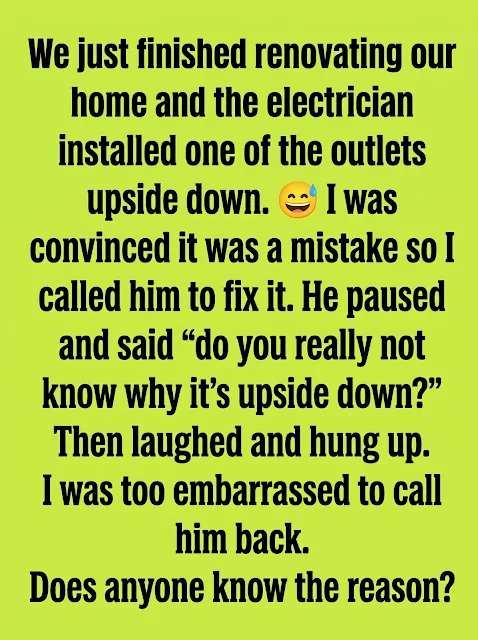
There are several reasons an electrician or facility might choose that orientation.
One of the most commonly discussed reasons involves what happens if a plug partially falls out of the receptacle.
Imagine a heavy plug is connected to an outlet.
Over time, gravity or tension from the cord causes the plug to sag.
If the grounding pin is at the top, it can remain engaged with the grounding contact while the energized blades are partly withdrawn.
That can be viewed as an additional safety consideration in certain situations.
The idea becomes particularly relevant with metal plugs or cords where something could potentially fall across exposed portions of the plug.
However, this doesn’t mean that every outlet should automatically be installed ground-up.
The actual safety of an installation depends on the receptacle, plug, equipment, wiring, environment, and applicable electrical requirements.
Ground-Up vs. Ground-Down: Which Is Safer?
This is where the answer gets a little less exciting—but much more accurate.
There isn’t one universal orientation that makes every residential receptacle safer.
You’ll find electricians and electrical professionals who prefer ground-up installation for certain applications, while others commonly install receptacles ground-down.
The important thing is that the receptacle is properly installed, grounded where required, and compliant with the applicable electrical code and manufacturer instructions.
The National Electrical Code establishes minimum requirements for electrical installations in jurisdictions that adopt it, but local authorities determine how and where the code is enforced.
So if you walk into a house and see some outlets ground-up and others ground-down, that doesn’t automatically mean the home has an electrical problem.
The Interesting Case of Hospitals and Commercial Buildings
You may notice unusual outlet orientations in places where electrical equipment is especially important.
Hospitals, workshops, commercial spaces, industrial facilities, and other specialized environments can have installation practices that differ from what you’re accustomed to seeing at home.
In some situations, the orientation may be deliberately selected based on the equipment being connected, the type of plug, or the facility’s electrical practices.
That’s why you shouldn’t assume that a ground-up receptacle was simply installed by someone who didn’t know what they were doing.
Sometimes it was intentional.
What About Plugs With a Metal Grounding Pin?
Here’s where the orientation can become particularly interesting.
Consider a plug with three prongs.
The third prong is the grounding connection.
If the plug is partially pulled out, the physical relationship between the grounding pin and the energized blades depends partly on the orientation of the receptacle and the plug.
With the grounding opening positioned on top, the grounding pin can potentially remain engaged longer as the plug begins to sag out of the receptacle.
This is one reason some electricians favor ground-up orientation in particular applications.
But again, don’t treat this as a universal code requirement.
The entire electrical installation—not simply the direction of the receptacle—determines whether the system is safe.
Does Turning an Outlet Upside Down Change the Electricity?
No.
This is one of the biggest misconceptions.
If a properly wired receptacle is physically rotated 180 degrees, the electrical circuit doesn’t suddenly reverse.
The hot contact is still connected to the hot conductor.
The neutral contact is still connected to neutral.
The grounding contact is still connected to the grounding system.
You’re changing the physical orientation, not the fundamental electrical function.
That’s why an appliance doesn’t care whether the grounding hole is above or below the two vertical slots.
The plug still connects to the same contacts.
Is an Upside-Down Outlet a Sign of Bad Wiring?
Not necessarily.
This is important because people sometimes see an outlet with the ground pin on top and immediately assume:
“Someone wired this wrong.”
The orientation alone isn’t enough evidence to make that conclusion.
A receptacle can be installed ground-up and function perfectly normally.
If you’re concerned about an outlet, look for actual warning signs instead:
- Loose receptacle
- Cracked or damaged faceplate
- Burn marks
- Discoloration
- Buzzing or sizzling sounds
- Burning smell
- Sparks
- Plugs that fall out easily
- Repeatedly tripping breakers
- Warm or hot receptacle covers
Those are much more meaningful reasons to have an electrical installation inspected.
The Electrical Safety Foundation International recommends that outlet installations be performed by qualified electricians and emphasizes inspection of electrical wiring and devices for safety problems.
What If the Outlet Is Loose?
That’s different.
A loose receptacle shouldn’t simply be ignored because “it’s still working.”
When a receptacle moves significantly when you plug something in or remove a plug, the electrical box or mounting arrangement may need attention.
Repeated movement can also make plugging and unplugging less secure.
If you’re not experienced with electrical work, this is a good time to call a qualified electrician rather than removing the cover and experimenting.
Electricity is not a great place for trial and error.
What About Outlets Near Water?
This is an even more important safety issue than whether the ground pin is facing up or down.
Areas where electricity and water may come into contact generally require ground-fault protection, such as GFCI protection, under applicable electrical codes.
GFCIs are designed to interrupt power when they detect an imbalance in electrical current, helping reduce the risk of serious shock.
So if you’re evaluating an outlet in a kitchen, bathroom, garage, laundry area, or outdoors, don’t focus only on its orientation.
Ask the more important question:
Does the electrical installation have the appropriate protection for its location?
What Is a GFCI Outlet?
You may have seen an outlet with two buttons labeled:
TEST
and
RESET
That’s typically a GFCI receptacle.
Its job is to monitor electrical current and shut off power when it detects a ground fault.
These devices are especially important in locations where electricity could come into contact with water.
The ESFI recommends testing GFCI protection regularly to make sure it is functioning properly.
And notice something interesting:
A GFCI can be installed ground-up or ground-down.
The safety mechanism isn’t dependent on which direction the face of the receptacle is pointing.
What About Child Safety?
The orientation of a receptacle shouldn’t be confused with child protection.
If you’re concerned about children and electrical outlets, the more relevant feature is a tamper-resistant receptacle, commonly abbreviated TRR.
Tamper-resistant receptacles contain internal shutters that help prevent objects from being inserted into the slots unless appropriate pressure is applied simultaneously, such as when a proper plug is inserted.
So turning an ordinary outlet upside down isn’t a substitute for a tamper-resistant receptacle.
That’s an important distinction.
Why Do Some Houses Have Both Orientations?
This is probably the part that makes people scratch their heads.
You might walk into a house and see:
Outlet 1: Ground down
Outlet 2: Ground up
Outlet 3: Ground down
Outlet 4: Ground up
What happened?
There are several possibilities.
Different electricians may have installed or replaced different receptacles over the years.
A previous homeowner may have replaced some outlets.
A renovation may have changed certain receptacles while leaving others untouched.
Or some outlets may have been intentionally oriented differently for specific equipment or installation preferences.
In other words, inconsistent orientation doesn’t automatically mean inconsistent wiring.
Should You Rotate Your Outlets?
If you’re looking at your outlets and thinking, “Now I want them all facing the same direction,” I’d resist the urge to start turning them around yourself unless you’re qualified to do electrical work.
Rotating a receptacle involves working with electrical wiring, and simply flipping the device isn’t a job to approach casually.
If an outlet needs replacement, repair, or reorientation, have a qualified electrician handle it.
The ESFI specifically advises that outlet installations be performed by qualified electricians.
Is There a “Correct” Direction?
The short answer is:
Not simply based on appearance.
Ground-down may be what you’re most accustomed to seeing.
Ground-up may be intentional in some installations.
Neither orientation, by itself, tells you whether an electrical system is properly installed.
Applicable electrical codes, manufacturer instructions, the type of receptacle, the environment, and the specific installation all matter.
And that’s why the phrase “upside-down outlet” can be a little misleading.
It isn’t necessarily upside down at all.
It’s simply oriented differently from what you’re used to seeing.
Frequently Asked Questions
Why are some outlets installed upside down?
Some receptacles are intentionally installed with the grounding opening on top. One reason sometimes cited is the way a three-prong plug behaves if it partially pulls out or becomes stressed by the cord. Other installations simply reflect electrician preference, local practice, equipment requirements, or replacement history.
Is a ground-up outlet safer?
There isn’t a universal answer that makes ground-up safer in every installation. The overall installation and applicable electrical requirements matter more than the visual orientation of the receptacle.
Is it dangerous if my outlet is upside down?
Not necessarily. Ground-up orientation by itself doesn’t indicate a dangerous electrical installation.
Does an upside-down outlet mean it was wired incorrectly?
No. The physical orientation of a receptacle doesn’t by itself tell you whether the wiring is correct.
What does the third hole on an outlet do?
It’s the grounding contact. On a properly grounded system, it connects compatible equipment to the equipment grounding path, which provides an important fault-current path and helps protect against electric shock.
Should the ground hole be on top or bottom?
Either orientation may be encountered. Follow the applicable electrical code, manufacturer instructions, and installation requirements rather than assuming one orientation is universally correct.
Why are some outlets installed sideways?
Specialized installations can use different orientations depending on the receptacle, equipment, space, and installation requirements. A sideways receptacle isn’t automatically evidence of faulty wiring either.
Should I replace an old outlet because it’s upside down?
Not solely because of its orientation. If an outlet is damaged, loose, discolored, hot, sparking, buzzing, or otherwise behaving abnormally, have it inspected by a qualified electrician.
The Bottom Line
So the next time you see an electrical outlet that looks upside down, don’t immediately assume somebody messed up.
That little grounding opening can be on top for perfectly legitimate reasons.
In some installations, the orientation may be chosen deliberately because of how plugs behave when they become partially disconnected. In others, it may simply reflect the electrician’s preferred orientation, a particular installation practice, or the history of the building.
The important thing is that the receptacle is properly installed, appropriately grounded, and suitable for its location and intended use.
And now that you know this, you may start noticing something funny.
Once you begin looking at electrical outlets, you’ll realize they aren’t all facing the same direction.
Some are ground-up.
Some are ground-down.
And some have clearly been there since before anyone remembers renovating the room.
So the next time someone points to one and says,
“That outlet is installed upside down!”
you can tell them:
“Maybe. But maybe it isn’t.”
And that little third hole?
It’s doing a lot more than making the outlet look like a tiny surprised face.
There’s more to discover. Continue to the next page for the rest of this article.