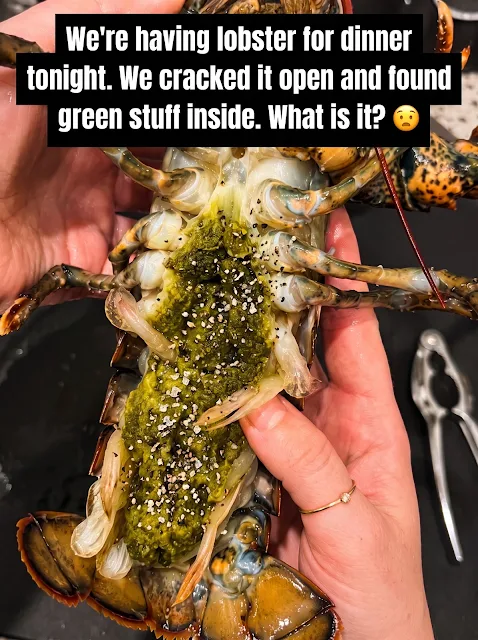
If you’ve ever cracked open a beautifully cooked lobster and spotted that strange green, creamy, sometimes slightly grainy substance tucked inside, you may have paused for a second and thought, Wait… what IS that?!
You’re definitely not alone!
That mysterious green material has sparked plenty of dinner-table conversations, curious guesses, and more than a few nervous reactions. It can look unusual enough to make you wonder whether the lobster is safe to eat—or whether you’ve accidentally discovered something you weren’t supposed to.
The good news? Lobster’s green “goodies” are a perfectly natural part of the animal. They have an important biological function and even have a name: tomalley.
But there’s an important twist to this story.
Although tomalley is a normal lobster organ, health authorities advise consumers not to eat it, because this tissue can accumulate contaminants and, under certain conditions, marine toxins. The lobster meat itself is a different story.
So let’s crack this mystery wide open!
What Is the Green Stuff Inside a Lobster?
That green substance is called tomalley.
Biologically, it is the lobster’s hepatopancreas, an organ that performs functions associated with both the liver and pancreas in other animals.
It sits inside the lobster’s body cavity and plays an important role in digestion and processing nutrients.
So when you see that soft green material after opening a cooked lobster, you’re not looking at spoiled meat, leftover food, or something that appeared because the lobster was cooked incorrectly.
You’re looking at one of the lobster’s internal organs.
And yes, it really can be green, yellow-green, olive-colored, creamy, or slightly grainy.
That’s completely different from the lobster meat, which should have the familiar firm, pale appearance you’d expect from properly cooked lobster.
Why Is Lobster Tomalley Green?
This is one of the most fascinating parts!
The tomalley is involved in digestion and nutrient processing, and its color comes from the pigments and contents associated with the organ.
Unlike lobster meat, which is primarily muscle tissue, tomalley is an organ with a completely different biological job.
That’s why the texture and appearance can be so dramatically different.
It may look like a soft green paste tucked underneath the shell, almost like a strange seafood pâté.
And depending on the lobster, the color and consistency can vary.
Is Green Tomalley Normal?
Yes.
Finding green material inside a cooked lobster isn’t, by itself, a sign that something is wrong.
In fact, if you’ve opened many lobsters, you’ve probably noticed that some contain much more tomalley than others.
That’s simply part of the natural variation between animals.
Is Tomalley the Same as Lobster Roe?
No—and this is an easy thing to confuse!
Tomalley and lobster roe are different.
Tomalley is the lobster’s hepatopancreas.
Roe refers to eggs. In a female lobster, eggs can appear as small orange, red, or darker-colored clusters depending on their stage of development.
So if you see something orange or red rather than green, you’re looking at something different.
The lobster can contain several distinct internal tissues, and not everything you see inside the shell is lobster meat.
Why Did People Traditionally Eat Lobster Tomalley?
Here’s where things get interesting.
For generations, some people have considered tomalley a delicacy.
Its soft, rich texture and concentrated seafood flavor have made it appealing to people who enjoy eating the less familiar parts of shellfish.
Some lobster lovers describe it as intensely savory, briny, buttery, or almost pâté-like.
And historically, the idea of eating as much of the animal as possible wasn’t unusual.
But tradition doesn’t automatically mean something is recommended from a modern food-safety perspective.
Today, health authorities advise against eating lobster tomalley.
Is Lobster Tomalley Safe to Eat?
This is the part I really don’t want to gloss over.
The fact that tomalley is natural does not mean it is always considered safe to eat.
The FDA has identified lobster tomalley as a tissue that can contain paralytic shellfish poisoning (PSP) toxins, particularly when lobsters are harvested from affected waters. FDA guidance notes that these toxins are not reliably eliminated by cooking.
Maine health authorities likewise advise consumers not to eat lobster tomalley because it can accumulate environmental contaminants and biotoxins.
So while that green stuff may look completely normal—and often is a normal part of the lobster—it is not something I would recommend eating.
What About the Lobster Meat?
Here’s the reassuring part.
The safety concern about tomalley does not mean you need to throw away perfectly good lobster meat.
FDA guidance has specifically distinguished the tomalley from lobster muscle meat when discussing PSP concerns. In its earlier advisory, FDA noted that lobster meat was typically unaffected even when elevated PSP toxin levels were found in tomalley.
Of course, seafood should always come from a safe, approved source and be handled and cooked properly.
Does Cooking Destroy the Toxins in Tomalley?
There’s more to discover. Continue to the next page for the rest of this article.