There’s a fascinating phenomenon called pareidolia, which describes the tendency to perceive a recognizable pattern—often a face or familiar object—in something that doesn’t actually contain that object.
It’s why people see faces in:
Clouds
Tree bark
Rock formations
Toast
Building fronts
Shadows
Wood grain
Random patterns
Your brain is constantly searching for meaningful patterns.
That’s generally useful.
Imagine trying to recognize a friend in a crowded room. Your brain has to quickly interpret incomplete and constantly changing visual information.
A hidden-image puzzle simply takes advantage of that same pattern-recognition ability.
Does the Animal You See First Reveal Your Personality?
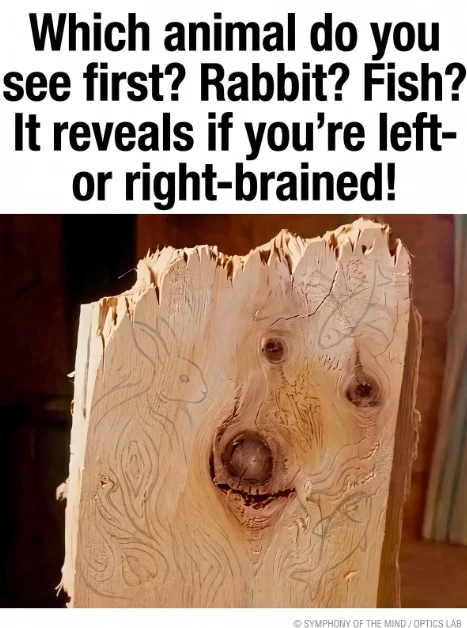
You may have seen posts claiming that choosing the rabbit, fish, or dog reveals something specific about your personality.
Those claims can certainly make these puzzles more fun to share with friends.
But they shouldn’t be treated as psychological tests.
There isn’t a reliable scientific rule saying:
“If you see the rabbit first, you are definitely this type of person.”
Your first visual impression can be influenced by many things, including the image itself, contrast, attention, viewing angle, expectations, and what your brain happens to notice first.
So enjoy the personality interpretations as playful entertainment, not as a diagnosis or scientific assessment.
Why Do People See Different Animals First?
There are several possible reasons.
Attention
Your eyes may naturally focus on one particularly noticeable part of the image.
Contrast
A darker or lighter area may attract your attention before everything else.
Familiarity
Your brain may be especially quick to recognize a shape you’ve encountered many times.
Expectations
If someone tells you to look for a rabbit, you may suddenly become more likely to notice rabbit-like features.
Visual Context
The surrounding shapes can influence how you interpret an ambiguous form.
And sometimes?
You simply notice something before somebody else does.
That’s part of the fun!
Try This With a Friend
Here’s a great way to turn the puzzle into a little challenge.
Show the image to a friend without telling them the three possible animals.
Ask:
“What do you see?”
Don’t give them any clues.
Then compare answers.
You might be surprised by how quickly the conversation turns into:
“How can you NOT see the fish?”
And your friend will probably respond:
“The fish? It’s obviously a dog!”
This is exactly why these puzzles are so shareable.
What Happens After Someone Reveals the Answer?
One of the strangest things about visual puzzles is how dramatically perception can change once you know what you’re looking for.
Before the reveal, a shape may seem completely random.
After someone points out the hidden animal, suddenly the ears seem obvious.
Or the tail.
Or the nose.
Or the body.
It’s almost as if your brain has switched from one interpretation to another.
The image itself hasn’t changed.
Your visual organization of it has.
Can You See All Three?
Here’s the real challenge.
After deciding which animal you saw first, go back and look for the other two.
Can you find the rabbit?
Now the fish?
And finally the dog?
Sometimes the second and third images are much easier to see once you’ve already discovered one.
That’s because you’ve learned what visual clues to search for.
Try turning the image slightly, stepping back, or changing the distance between your eyes and the screen.
You may suddenly notice details you completely overlooked the first time.
Why These Puzzles Are So Addictive
There’s a tiny reward involved in solving a hidden-image puzzle.
Your brain starts with uncertainty:
“What am I looking at?”
Then comes recognition:
“Wait… I see it!”
That moment of discovery is satisfying.
It’s the same basic appeal behind optical illusions, spot-the-difference games, hidden-object puzzles, and other visual challenges.
You’re not simply looking at a picture.
You’re trying to figure it out.
Don’t Feel Bad If You Can’t See the Animal
And here’s an important reminder:
If someone else spots the rabbit in two seconds and you don’t see anything resembling a rabbit after two minutes, that doesn’t mean there’s anything wrong with your eyesight or intelligence.
These puzzles depend heavily on interpretation.
Sometimes the particular image simply doesn’t “click” for you.
Then, suddenly, someone points out the shape—and there it is!
It can feel like a light switching on.
Frequently Asked Questions
Is there a correct animal to see first?
No.
The puzzle is designed around ambiguous shapes, so different viewers may notice different forms first.
Does seeing the rabbit mean something about my personality?
Not scientifically.
Personality descriptions attached to these puzzles are generally intended as entertainment rather than validated psychological assessments.
What is pareidolia?
Pareidolia is the tendency to perceive a recognizable pattern or object in an ambiguous or random visual stimulus.
Seeing faces in clouds is one of the most familiar examples.
Why can I see an animal after someone points it out?
Once you’re given a visual interpretation, your brain knows which features to search for. That can make previously ambiguous shapes suddenly appear meaningful.
Can I train myself to become better at these puzzles?
You can certainly become more practiced at looking for patterns and visual details.
Try slowing down, examining the image from different distances, and deliberately looking at negative space rather than only the obvious shapes.
Why do my friends see something completely different?
People don’t necessarily direct their attention to the same parts of an image. Differences in attention, experience, expectations, and visual interpretation can all contribute.
Are these puzzles intelligence tests?
No.
A hidden-image puzzle isn’t a reliable measure of intelligence.
It’s simply a visual perception challenge designed to be entertaining.
The Fun Part Is Comparing Answers
That’s really what makes this puzzle so enjoyable.
Maybe you saw the rabbit immediately.
Maybe the fish practically jumped off the screen.
Or perhaps you stared at the picture and thought, “I don’t see any animal!” before finally spotting the dog hiding in the shapes.
There is no wrong answer.
And if you’re sitting with somebody right now, this is the perfect excuse to show them the picture and ask the same question.
Just don’t tell them what you saw first!
Otherwise, you might accidentally give away the puzzle.
Final Thoughts
A picture can be surprisingly powerful.
A few unusual lines and shapes can look completely meaningless one second and then transform into a familiar animal the next.
That’s the charm of hidden-image puzzles.
They’re quick, simple, and just challenging enough to make you stop scrolling.
So take another look.
Rabbit? Fish? Dog?
Which one did your eyes find first?
And once you’ve chosen, don’t stop there.
See if you can find the other two.
Then send the puzzle to a friend and see whether they see exactly what you saw—or insist that you’re completely wrong!
That’s half the fun.
What Did You See First?
Rabbit, fish, or dog?
Leave your answer in the comments and see which animal other readers spotted first.
And if this puzzle made you look twice, share it on Pinterest or with a friend and challenge them to find all three.
Just remember: there’s no secret personality diagnosis hiding behind your answer.
The real prize is that wonderfully satisfying moment when the hidden shape finally appears
There’s more to discover. Continue to the next page for the rest of this article.